Abstract
When a language model develops capabilities not traceable to its individual components, when a multi-agent AI system outperforms each agent on its own, or when a human-AI pair succeeds where either fails in isolation, AI researchers describe it as a case of “synergy” or “emergence”. However, these are usually informal assessments not supported by a theoretical framework, making these claims impossible to compare or even meaningfully dispute.
Here we argue that information decomposition can serve as a unifying formal framework to operationalize assessments about synergy in AI systems. Information decomposition provides a way to distinguish qualitatively different types of information, including unique information available from individual components, redundant information shared across multiple components, and synergistic information accessible only from parts taken together. This gives claims of emergence a precise, falsifiable criterion: a system’s behavior is emergent only if it carries synergistic information about task-relevant outcomes.
We apply this lens to attention heads, autonomous agents, and human-AI teams, showing how it organizes existing knowledge across scales and substrates, while also generating cross-level conjectures that siloed fields would miss.
Our position
We propose PID—applied either as an exact computation or as a conceptual scaffold—as a framework to conceptualize collective intelligence across scales (within and across agents) and substrates (artificial and human).
Three Worked Examples
These cases differ in scale and substrate, yet make the same structural claim: the capabilities of the whole became “more than the sum of its parts.” Each is a full paper in its own right.
Within LLMs
A Brain-Like Synergistic Core in LLMs Drives Behaviour and Learning
Urbina-Rodriguez et al. · arXiv:2601.06851
Read the paper →Across agents
Emergent Coordination in Multi-Agent Language Models
Riedl · ICLR 2026
Project page →Humans + AI
Quantifying Human-AI Synergy
Riedl & Weidmann · 2026
Project page →A Primer on Partial Information Decomposition
PID focuses on a deceptively simple question: given a collection of variables representing the parts of a system, how is the information they contain distributed among them? Concretely,
- how much of that information is contained in individual variables alone (unique information),
- how much is contained in several different variables (redundancy), and
- how much is contained in groups of variables without being accessible from any subset of them (synergy)?
Formally, PID considers source variables \(X_1, \dots, X_n\) that hold information about a target variable \(Y\). For example, \(X_i\) could represent behavioral time-series of agents in a multi-agent system and \(Y\) their performance. The total information that the sources have about the target is captured by Shannon’s mutual information \(I(X_1,\dots,X_n;Y)\). For \(n=2\) sources, PID decomposes it into four information atoms:
$$I(X_1,X_2;Y) = \underbrace{\mathrm{Red}(X_1,X_2;Y) + \mathrm{Un}(X_1;Y|X_2)}_{I(X_1;Y)} + \underbrace{\mathrm{Un}(X_2;Y|X_1) + \mathrm{Syn}(X_1,X_2;Y)}_{I(X_2;Y|X_1)}$$This gives three equations and four unknowns. Establishing how to calculate one of the above atoms determines the others. A common choice is to specify their redundancy via the minimum mutual information (MMI) criterion, \(\mathrm{Red}(X_1,X_2;Y) = \min\{I(X_1;Y), I(X_2;Y)\}\). The PID literature has proposed several alternatives, and none of them is universally preferable—practitioners need to choose between operationalizations based on domain knowledge and properties of the data and problem of interest.
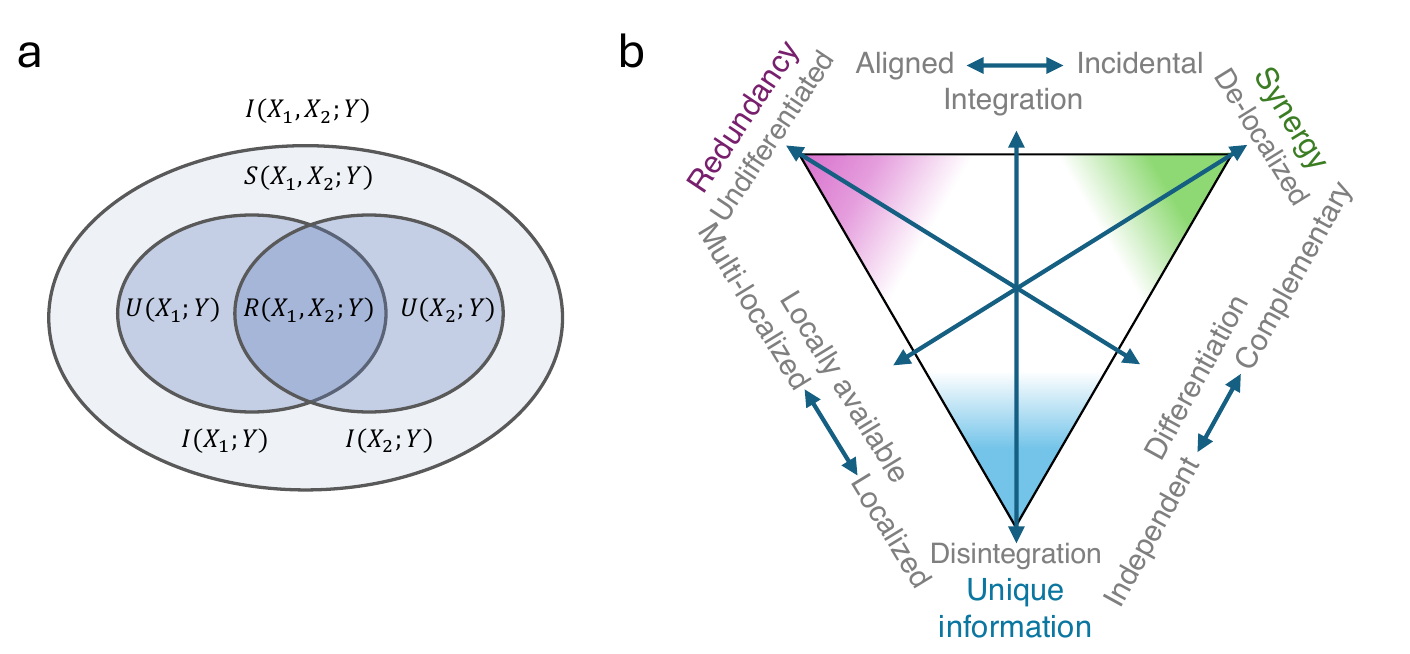
Figure 1. a) Information decomposition with two source variables \(X_1\) and \(X_2\), and target variable \(Y\). b) The PID conceptual triangle resolves ambiguities in system dynamics. Integration conflates redundancy (integration-as-oneness) with synergy (complementary cooperation). Differentiation conflates unique information (strict independence) with synergy (interactive differentiation). Locality conflates unique (singularly local) with redundant (multiply local) information, whereas synergistic representations are strictly de-localized (adapted from Luppi et al.).
For \(n \ge 3\) sources the number of information atoms grows super-exponentially, making the full decomposition intractable for six or more variables. Practical strategies include targeting specific atoms of interest, evaluating reduced decompositions, computing the full decomposition over small subsets (e.g., all triplets) and aggregating, or computing scalar summaries such as the O-information.
The distribution of information across PID atoms dictates a fundamental architectural tradeoff: redundant information provides robustness (since it is found in multiple signals) while synergistic information provides efficiency. Even without engaging with the computational aspects of PID, the conceptual toolkit and vocabulary of redundant, unique, and synergistic information allow researchers to navigate important tradeoffs that are central for understanding complex systems.
PID entails four architectural principles governing synergy in any system—circuit, agent team, or human-AI collaboration:
Differentiation requirement
To generate synergy the system’s components must be either functionally differentiated or modularized by context. If the parts are perfectly synchronized, cloned, or otherwise highly coupled, they can only provide redundant information.
Representational capacity
Synergy provides functional advantages as it can encode more information than redundancy atoms for a given system size.
Temporal emergence
Emergent properties are not present in the instantaneous microstate alone, but arise diachronically through processes unfolding over time.
Fragility-vs-robustness tradeoff
Synergy is associated with fragility, while redundancy is inherently robust. Because emergent synergy relies on precise structural heterogeneity, it is inherently unstable and highly sensitive to the specific input signals.
Three Tests of Emergence
How can one test whether the whole is more than the sum of its parts? Building on the idea of information decomposition, one can cast emergence as information about a system’s temporal evolution (future states of the whole) that cannot be traced to the current state of its parts. This gives a data-driven, quantifiable criterion amenable to empirical testing with falsifiable conjectures against specific null hypotheses.
1. Emergence capacity
Probes the ability of a system to host any emergent variable. For each pair of sources \((i,j)\), define the target as their joint future state \(T_{ij,t+\ell} \equiv (X_{i,t+\ell}, X_{j,t+\ell})\), where \(\ell\) is the integration timescale, and compute the two-source PID. A positive pairwise dynamical synergy
$$\mathrm{Syn}_{ij} > 0$$indicates that the macro captures predictive information about the joint future not recoverable from any single component. A common approach is to take the median over all pairs as system-level synergy capacity. Limited to synergy of order \(k=2\), but does not rely on the definition of a whole-system macro signal.
2. Unique information criterion
Evaluates a specific macroscopic feature \(V_t\) against the formal criteria for causal emergence: a feature \(V_t\) is emergent if it possesses predictive power about the system’s future that is unique with respect to the state of its individual parts:
$$\mathrm{Un}(V_t; X_{t+\ell} \mid X_t) > 0$$While this is the most theoretically rigorous way to identify an emergent feature, it is computationally demanding because it requires full knowledge of the statistics of the—potentially high-dimensional—microscopic dynamics.
3. Practical criterion
Asks whether a macro signal \(V_t = f(X_t)\) contains predictive information beyond any individual part:
$$\Psi_\ell(V) = I(V_t; V_{t+\ell}) - \sum_{k=1}^{n} I(X_{k,t}; V_{t+\ell})$$A positive value indicates that the macro’s self-predictability exceeds what the sum of its parts can explain, indicating dynamical synergy. It acts as a coarse, order-agnostic screen sensitive to synergy of any order \(\ge 2\). However, it is penalized by redundancy across parts, which can make the score negative even when higher-order synergy exists.
Quick start: the three emergence tests on a toy Ising system
A minimal, exactly solvable system on which the emergence capacity, unique-information and practical criteria can be understood before being applied to real data. github.com/riedlc/emergence →
Worked example 1
Synergy Within LLMs
How is information processing organized within LLMs? Urbina-Rodriguez et al. treat attention heads and mixture-of-experts (MoE) modules as nodes, record each unit’s token-by-token activity, and apply a time-lagged PID (ΦID) to the resulting multivariate time series. They compute bivariate ΦID for every pair of heads (or experts), which they aggregate into a per-unit synergy-redundancy rank.
Middle layers show synergistic processing while early and late layers exhibit a dominance of redundancy—a striking analog of the unimodal-to-transmodal gradient observed in the human brain. These results hold across multiple LLM families. Moreover, the synergistic core is learned, not hardwired: it is absent in randomly initialized networks. The synergistic core is causally necessary for capabilities that demand integration: ablating synergistic heads degrades complex task performance disproportionately compared to ablating redundant heads. RL-based fine-tuning of synergistic regions produces larger performance gains than fine-tuning redundant components.
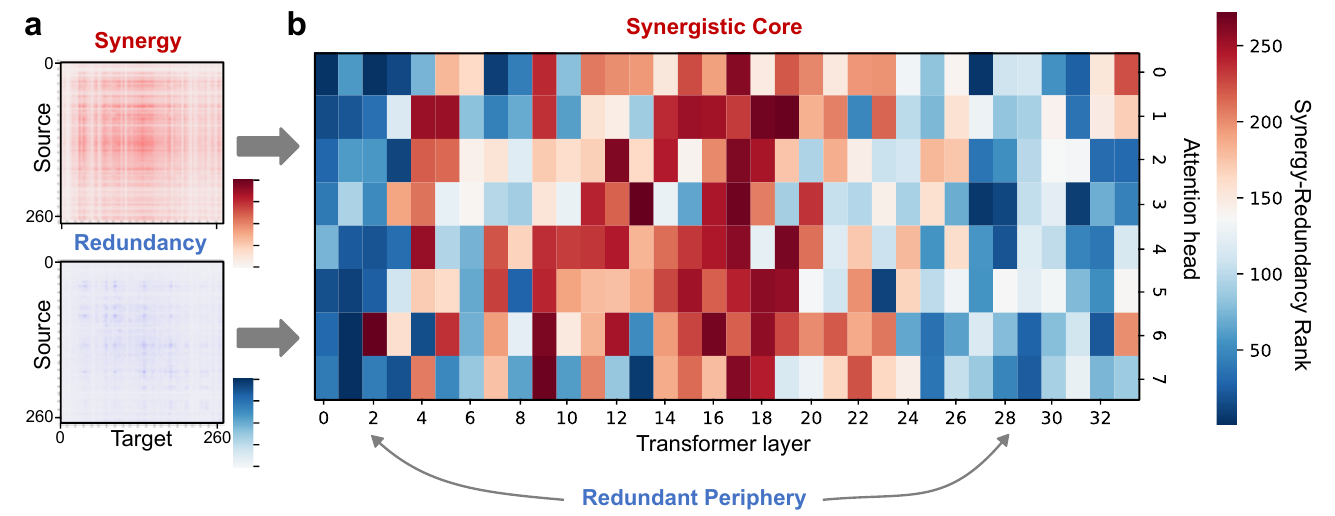
Figure 2. LLMs exhibit a synergistic core surrounded by a redundant periphery. a) Heatmaps of synergy and redundancy between pairs of attention heads in Gemma 3 4B. b) Heatmap of the synergy-redundancy ranks in Gemma 3 4B. Adapted from Urbina-Rodriguez et al.
Worked example 2
Synergy Across Agents in Multi-Agent Systems
When multi-agent systems outperform single agents, authors often attribute this to “greater-than-the-sum-of-its-parts” effects. To test if this emergence is genuine, Riedl developed a simple group task in which agents propose integers whose sum needs to match a hidden target number. Blind to group size and peers’ guesses, agents receive only collective “too high” or “too low” feedback. A Theory of Mind (ToM) condition instructs agents to “think about what other agents might do.”
Using group error as macro signal, both the emergence capacity criterion and the practical emergence criterion are significantly above zero, confirming dynamical emergence. Total Stability is indistinguishable from zero in the Plain and Persona conditions but sharply elevated in the ToM condition. This suggests the ToM intervention acts as a control parameter, steering the multi-agent system from a chaotic regime into a deep basin of attraction where collective behavior stabilizes. Neither synergy nor redundancy alone predicts success, while their interaction does: multi-agent coordination requires balancing integration with differentiation across the PID lattice.
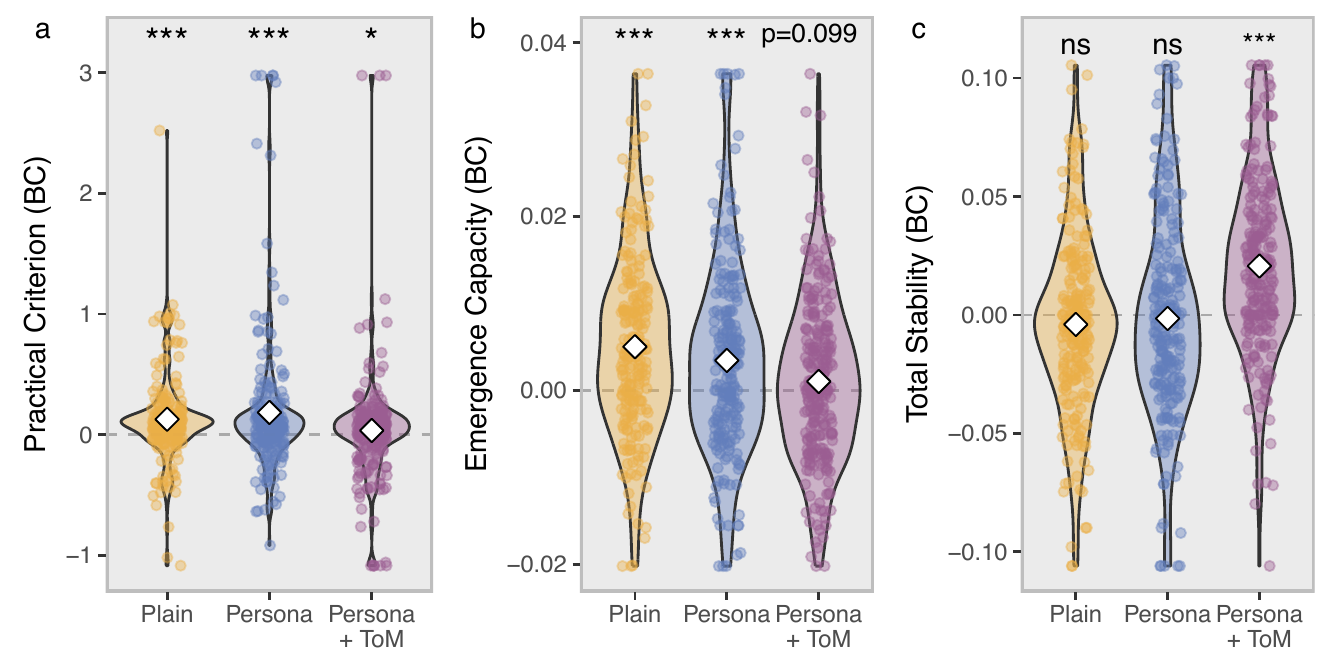
Figure 3. Emergent synergy in multi-agent LLM systems. a) Practical emergence criterion (bias corrected). b) Emergence capacity dynamical synergy (bias corrected). c) Total Stability (time-delayed mutual information of triplets). Stars indicate significance level of Wilcoxon test. Adapted from Riedl (ICLR 2026). *** p < 0.001; * p < 0.05.
Worked example 3
Human-AI Synergy
Studies of human-AI interaction typically measure performance uplift by comparing a “human-only” and a “human-and-AI” condition. Those comparisons do not distinguish whether gains are additive, substitutive, or non-linearly synergistic. Riedl and Weidmann studied human-AI collaboration using item response theory, isolating latent AI ability, human solo ability, and human collaborative ability. We map this behavioral decomposition onto the conceptual lattice of PID:
$$I(H,A;Y) = \mathrm{Un}(H) + \mathrm{Un}(A) + \mathrm{Red}(H,A;Y) + \mathrm{Syn}(H,A;Y)$$Because the emergence criterion requires only \(\mathrm{Syn} > 0\), one does not need to isolate the synergistic atom directly: it suffices to bound the other three and show that a positive residual survives. The residual is not unique human information—solo and collaborative ability are statistically distinct latent traits. The residual is not unique AI information—users still improve significantly on items the AI could not solve alone. Redundancy is starved on the hard-item regime. And the residual carries the structural fingerprint of synergy: human ToM predicts collaborative but not solo ability, and when ToM is zero, access to AI provides no benefit.
Taken together, these tests leave a positive residual that none of the other three atoms can absorb, which is a lower bound on \(\mathrm{Syn}(H,A;Y)\) and exactly what the emergence criterion requires, obtained from evidence never collected with PID in mind.
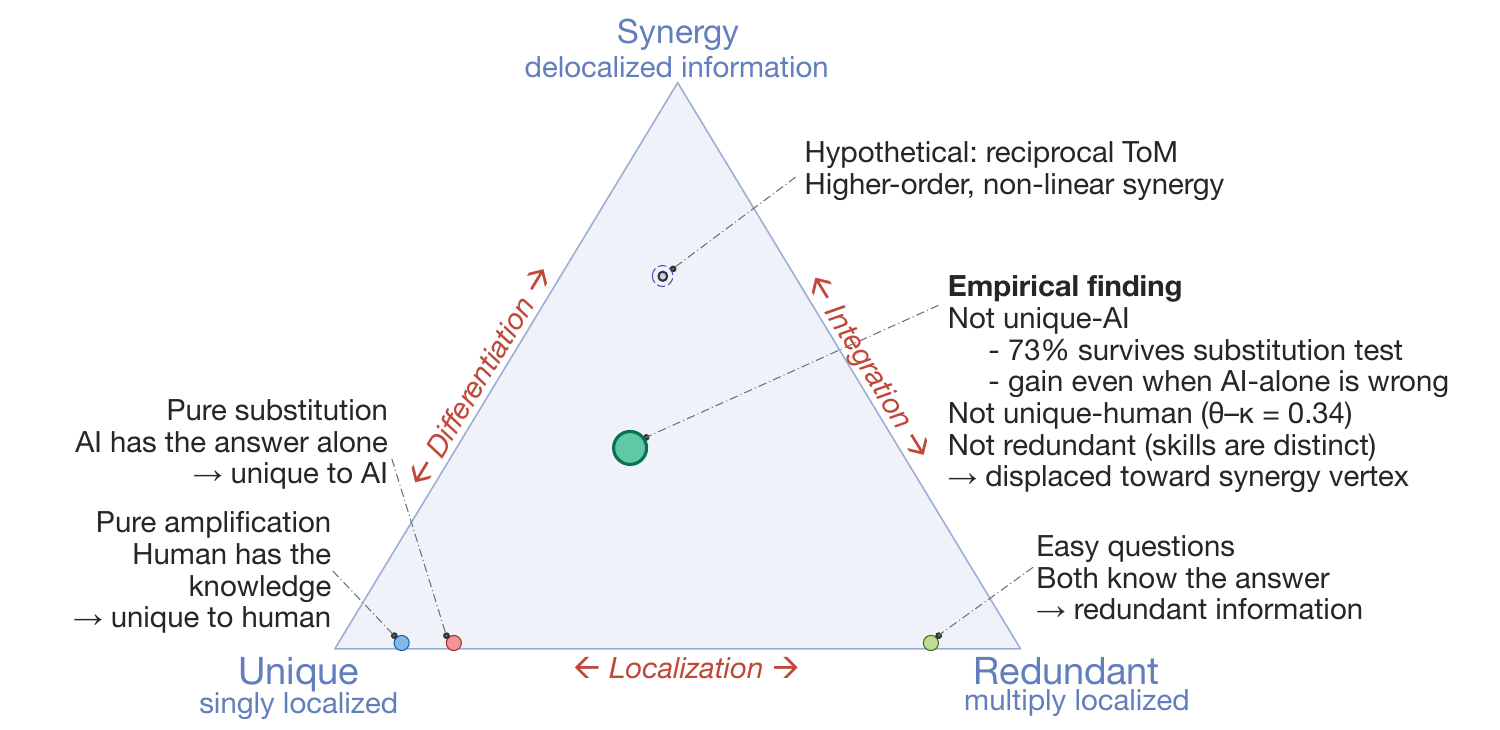
Figure 4. Viewing human-AI synergy through an information decomposition lens unifies existing theories about substitution, linear and non-linear complementarity.
Five Cross-Level Conjectures
This perspective reveals hidden cross-layer connections to guide future research, which we summarize in five conjectures with testable hypotheses.
Exhibit
Conjectures and hypotheses in testable form
| Conjecture | PID account | Testable hypothesis |
|---|---|---|
| 1 Grokking as redundancy-to-synergy transition | Grokking should correspond to a measurable phase transition in the PID spectrum: redundancy-dominated during memorization, shifting abruptly to synergy at the generalization jump. | Track O-information Ω of the hidden representation across training; confirmed if Ω flips from positive to negative within the test-accuracy jump (and an Ω-penalty delays it), falsified if Ω drifts smoothly with train accuracy. |
| 2 Jagged intelligence as a factored-representation boundary | Task difficulty tracks not human-perceived difficulty but synergistic depth: the degree to which the correct answer depends on jointly considering independently informative factors. | Score each task by synergistic depth \(\mathrm{Syn}(F_1,\dots,F_k;Y)\); confirmed if accuracy falls with depth after partialling out human-rated difficulty, falsified if accuracy is unrelated to Syn or difficulty dominates once depth is controlled. |
| 3 Test-time compute as synergy unrolling | CoT acts as an algorithmic compressor of per-step synergistic load, converting within-pass synergistic integration into sequential redundant lookbacks across tokens. | Measure per-pass synergy (synergy-redundancy rank) for a reasoning vs. base model; confirmed if the reasoning model shows lower per-pass synergy and compute gains shrink with synergistic depth, falsified if its per-pass synergy is equal or higher. |
| 4 Multi-turn degradation and path-dependent synergy collapse | Multi-turn degradation, input-order sensitivity, and prompt-sequence effects in multi-agent settings share one cause: disrupted access to synergistic information. | Regress the single-turn-minus-multi-turn accuracy drop Δ on synergistic depth; confirmed if Δ rises with depth and is zero for redundancy-dominated tasks (Ω > 0), falsified if Δ is uncorrelated with depth. |
| 5 Theory of mind as a cross-level control parameter | Across all three levels, a structurally analogous mechanism shifts systems from factored to synergistic processing: high-ToM human inputs should differentially activate the model’s synergistic core. | Vary input ToM demand (e.g., via CausalToM) and measure synergy-redundancy rank of the synergistic-core heads; confirmed if high-ToM inputs raise core synergy but not the periphery, falsified if core synergy is insensitive to ToM demand. |
Practical Guidelines
The choice of parts, target, timescale, and redundancy measure is not given by the theory. Claims about synergy and emergence are bounded by those modeling choices, which should be founded on theoretical arguments and supplemented by robustness tests.
| Stage | Question | Recommended approach | Key caveat |
|---|---|---|---|
| Decide | What are the parts, target, and timescale? | Fix parts, target, timescale ℓ, and redundancy measure on theoretical grounds | Not given by the theory; claims are bounded by these choices. Substantiate claims by demonstrating robustness across granularities (e.g., heads and experts), orders (e.g., pairs/triplets), and targets (e.g., group error and principal component) |
| Estimate | Small system (n ≲ 5), full structure needed | Exact PID, named redundancy measure (BROJA bivariate; Iccs/Imin discrete) | Report the measure; check ≥ 2 for robustness |
| Large system, net balance suffices | Localized/gradient O-information | Conflates Red/Syn; use per-node, not one global number; report strength measure (S-information or total correlation) to distinguish more synergy from less redundancy; size-matched random baseline to address bias | |
| “Is there any emergence?” screen | Emergence-capacity (pairwise Syn > 0); Ψℓ(V) > 0 | Negative Ψ inconclusive (redundancy subtracted up to n times); consider redundancy-corrected Ψ(k, q) | |
| LLM circuits—which units | Pairwise/subset synergy → per-node ranks (as in the core work) | Blind to high-order; needs null; add ablation for causal claims | |
| Dynamical / multi-agent over time | TDMI-based causal-emergence / ΦID | Requires block-shuffled nulls; timescale ℓ is a choice; state ℓ and report at least one alternative ℓ | |
| Continuous non-Gaussian activations | Copula normalization or non-parametric estimators | Gaussian PID may misestimate; report sample-size sensitivity | |
| Report | Reporting Syn estimates | Establish that findings are generated by interaction, not simple diffusion, shared experimental cues, autocorrelation, estimator bias, finite-samples bias, bias from alphabet size, etc.; report bias-corrected estimate against a suitable null (block-shuffled for time series; row-shuffled or functional otherwise) | Syn is a residual of large estimated quantities, so error compounds; plug-in MI is positively biased and inflates synergy |
| Comparing across conditions, models, or layers | Normalize (by H(target) or I(X;Y)) or use synergy–redundancy ranks; matched nulls per condition | Differences in source entropy masquerade as differences in synergy; result depends on null family | |
| Interpret | Making causal claims | Attribute synergy to a design lever; randomize the lever (ablation, persona, ToM prompt, routing k) | Observational synergy ≠ interventional synergy; correlational PID alone does not license a causal reading |
| Making mechanism claims | Treat PID atoms as a description of behavior; support mechanism claims by ablation or by fitting models of increasing interaction order and comparing their fit | High-order behavior ≠ high-order mechanism |
Table S1. Practical guidelines for applying information decomposition across the research workflow.
Reporting Guidelines for Synergy Claims
Box S1
Claims about synergy or emergence can be compared and disputed only if the choices that bound it are visible. Table S1 recommends which analysis to run; this box outlines how to report them.
A. The claim
- Quantity and sign: exact quantity, expression, sign convention.
- Order: n, order k detected, how larger systems were reduced and aggregated (rule and range across subsets).
- Reading: observational vs. interventional; behavior vs. mechanism; highest rung reached (detect → localize → identify causally → control → predict).
- Scope: systems, tasks, and scales covered; generality asserted and the cross-context evidence; what the claim does not show.
B. The modeling choices
- Parts: unit, reason for the granularity, one alternative.
- Target: Y or macro V; fixed, derived, or learned; one alternative.
- Timescale: static or dynamical; numeric ℓ; sensitivity across ℓ.
- Redundancy measure: which, why, non-negativity, a second measure from a different family, able to disagree with the first.
- Estimator and sample: data model, residualization, discretisation, N vs. alphabet and effective N (autocorrelation, mixing), bias correction.
C. The comparison
- Null model: what it preserves and destroys; surrogates; correction; nulls are one-sided.
- Strength beside balance: report Ω or Ψℓ(V) next to total information.
- Whole-minus-sum caveat: negative Ψℓ(V) is inconclusive; a positive Ψℓ(V) with a vanishing sum term reflects the macro, not synergy; redundancy is subtracted up to n times.
D. The pipeline
- Ground truth: pipeline recovers known atoms on COPY, XOR, AND, and UNQ; the last separates MMI from BROJA.
- Provenance: software versions, code, seeds, replicates, sample counts.
How to use this box. These are questions a claim should be able to answer, not conditions to be satisfied. Every item has legitimate exceptions; state the reason rather than tick the box. An item that cannot be answered should be reported as unanswered rather than omitted. Reasoned deviation is good practice; silent deviation is what this box is meant to end.
Citation
@inproceedings{riedl2026claims,
  title     = {Claims of emergence in AI should be grounded in information decomposition},
  author    = {Riedl, Christoph and Rosas, Fernando E.},
  booktitle = {Advances in Neural Information Processing Systems},
  year      = {2026},
  volume    = {39},
  url       = {https://arxiv.org/abs/2610.28479}
}
Copied!